
Part 3 of 4 of the Guide to delirium care by Alasdair MacLullich, Professor of Geriatric Medicine, University of Edinburgh.
Overview of delirium treatment
The treatment of delirium involves both addressing all the triggers and in parallel also managing the patient’s distress. Promoting recovery, keeping the patient safe, communicating properly with the patient and their family, and deciding on appropriate follow-up are also central to delirium care.
The SIGN Guideline on Delirium recommends 8 domains to consider when providing treatment to an person with delirium. This systematic approach can be termed Delirium 8 and the domains are shown here:
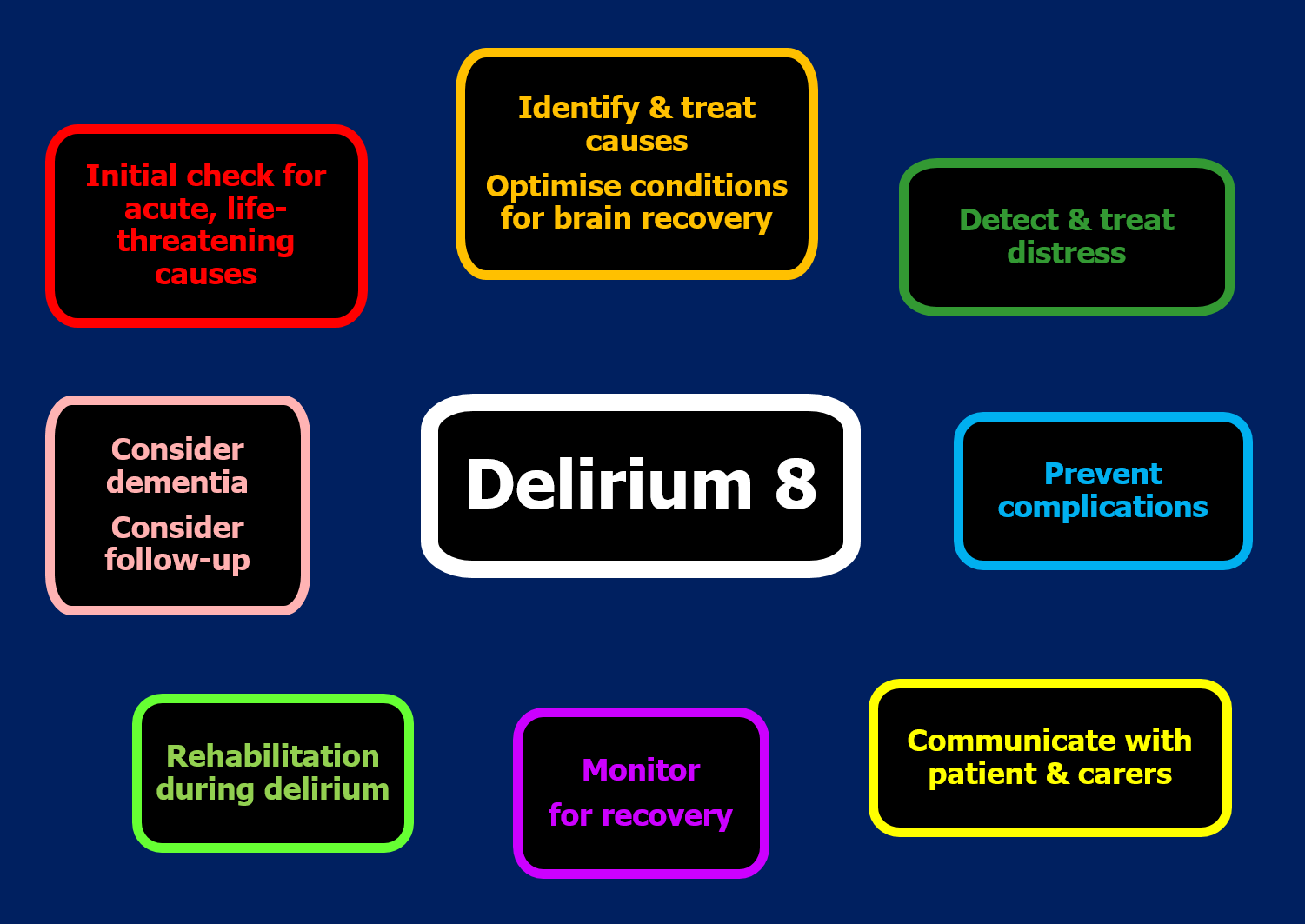
[1] Initial check for acute, life-threatening causes
Once delirium is suspected, it is necessary urgently to rule out acute, life-threatening physiological disturbance or drug toxicity. Consider for example low blood oxygen, high blood carbon dioxide, low blood pressure or low glucose, or recent administration of an opioid.
[2] Identify and treat causes / optimise conditions for brain recovery
Assuming that any immediate danger has been treated or ruled out, it is necessary to search for underlying causes (often multiple). Patients often have more than one cause, and so it is important to be systematic rather than stop at treating the first apparent cause. Consider potential pathology in each organ system, any metabolic abnormalities, drugs and drug withdrawal, psychological factors (e.g. stress resulting from hospital admission), and so on.
Also think of all the ways that conditions can be optimised to help the brain recover. This involves aiming to restore normal physiology as much as possible, providing fluids and food appropriately, avoiding constipation, avoiding a urinary catheter if possible, reviewing drugs (reducing or stopping drugs that might be contributing, but never suddenly withdrawing drugs where this not recommended), providing psychological support (reassurance, reorientation, avoiding isolation, involving family, etc.), facilitating healthy sleep through non-pharmacological means, and so on.
[3] Detect and treat distress
People with delirium are often distressed. There are many accounts of people who have had delirium who state that they were extremely frightened and that for some it was the worst experience of their lives. Also important are accounts that report that staff can make a large positive difference through how they interact with distressed patients.
When delirium is detected, part of the assessment should always be to look proactively for signs of distress. The first step is to observe the patient carefully. Do they look frightened or anxious? Are they frowning? Are they restless? If the patient is able to engage in conversation, ask direct questions about distress, e.g. ‘Are you feeling worried about anything?‘, ‘Do you need me to contact your family?‘), etc. Informant history from family or staff who know the patient well can also be useful.
If there is distress, then look carefully for common causes:
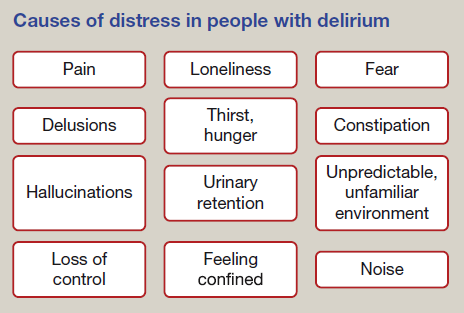
Pain, acute urinary retention and thirst are often missed (particularly in trauma patients) and are readily treatable. If the patient has delusions or is experiencing hallucinations, reassurance and clear explanation of where they are and what is happening to them can help. Start by introducing yourself and saying what your role is, then provide information such as: ‘You are in hospital now’, ‘It’s lunchtime’, and ask if they have any questions. As much as possible, involve the family in the care, with a focus on reorientation and reassurance. A family presence at the bedside can make a large difference, and if this is not possible even a phone call with a family member can make a person with delirium feel safer.
Drug treatment as part of delirium care: Despite multiple trials there is no evidence that drugs are effective in treatment of delirium as a whole. That is, there is no reason to prescribe a drug as a ‘treatment’ for delirium just because delirium has been diagnosed.
However, when a patient with delirium develops severe distress, particularly in association with psychosis (delusions and hallucinations), and non-pharmacological measures have been ineffective, then expert consensus supports a limited role for the use of drugs. Assuming no contraindications (check), antipsychotics are first line in most patients (though do consider the potential special circumstances of alcohol or benzodiazepine withdrawal). Small doses of risperidone (250mcg) or haloperidol (0.5mg) can be used. Monitor the QTc interval. Good practice is to administer 1 or 2 doses and assess response, usually stopping the drug at that time. Where patients are physically at risk to themselves or others or where more sedation is needed for safe medical treatment, higher and more frequent doses are sometimes needed. However, the principle of single or very short courses of drugs then reassessment still applies. Benzodiazepines again at low doses (e.g. 0.5mg lorazepam) are an alternative to antipsychotics.
Patients should not be given antipsychotics or benzodiazepines for several days or weeks in the context of delirium. If the drugs tried first are ineffective in controlling the symptoms alternative drugs as well as other strategies including other causes of distress such as pain or dehydration should be considered. Ongoing administration of antipsychotics for several days or weeks can lead to parkinsonism, falls, malnourishment, and worsened cognitive impairment.
Note that a small minority of patients in general settings (<10% in the experience of the author) need any specific psychotropic drug treatment as part of delirium care. It is not justifiable for it to be normal for all patients with delirium on a given ward or unit to be prescribed drugs as a response to a delirium diagnosis. The mainstay of delirium treatment is not drugs but general, systematic non-pharmacological as outlined in Delirium 8.
[4] Prevent complications
Delirium is a risky condition. It is linked with higher rates of immobility, dehydration, malnourishment, aspiration pneumonia, slow progress in rehabilitation, deconditioning, falls and pressure sores. When delirium is diagnosed, the patient should be considered at high risk of these complications and the care plan should aim to mitigate the risk.
[5] Communicate with patients and carers
Communication with patients and families is often omitted or done poorly. In particular, patients and families may not be informed of the diagnosis and what it means. This can have the consequence that they never know the diagnosis and instead think that it is dementia or another mental disorder. Using the word ‘delirium’ in the explanation, and providing access to leaflets or web links giving reliable information is essential in alleviating the uncertainty and worry that unidentified delirium commonly causes.
For a free, plain-English website and printable guides to share with families and carers, see Delirium Support
[6] Monitor for recovery
Most delirium resolves in 3-5 days, but around 20% of delirium persists for longer than this. Persistent delirium (which can be defined as delirium lasting 5 days or more) is associated with particularly poor outcomes. It is important to monitor for recovery in the days following diagnosis so that persistent delirium can be identified.
Monitoring for recovery can be done by assessing for improvement in the specific features of delirium that the person has, for example drowsiness or delusions. Tools such as the 4AT can be used to structure the assessment and if the delirium is persistent ongoing recording of positive scores on a delirium assessment tool is helpful in documenting and highlighting that the delirium is persisting or that it has resolved.
[7] Rehabilitation during delirium
Part of the treatment of delirium involves continuing engagement and, as far as possible, maintenance of normal activities. Rather than being left alone for hours without interactions or mobilisation, people with delirium should be encouraged to engage in conversation and to mobilise as much as they are able and safe to do. Additionally, rehabilitation from injuries or other insults should proceed as much as possible even if the person still has delirium. This can require modification of usual approaches to physiotherapy and occupational therapy.
[8] Consider dementia / consider follow-up
Many older people with delirium also have undiagnosed dementia. Cognitive testing is a routine part of the dementia diagnostic process but is not useful during delirium because the delirium itself affects performance on the cognitive tests. Instead, the possibility of dementia can be determined to an extent by the use of informant history, including use of the Informant Questionnaire for Cognitive Decline in the Elderly (IQCODE) which has been validated for use in patients with active delirium. If these assessments raise the possibility of dementia then appropriate follow-up may be indicated. This might involve cognitive testing and a functional assessment in 2-3 months if the delirium has definitely resolved.
Another reason for follow-up is if the patient has persisting symptoms and discharged from hospital with delirium. To ensure optimal ongoing care the patient should be monitored for recovery and if recovery is slow additional assessment may be helpful. Finally, some patients with delirium experience frightening delusions and hallucinations, and some can develop post-traumatic stress symptoms. These symptoms can be disabling and can be present long-term. If the patient has experienced these kinds of symptoms this should be recorded, and follow-up through primary care or another appropriate means offered.